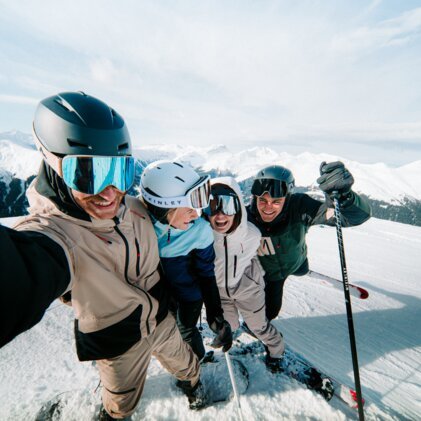
The days are getting shorter, the weather is getting darker and winter is just around the corner. While some people are looking forward to Christmas, others are planning their skiing holidays. What many people forget to do is to prepare themselves for it. The magic words for this are ski fit exercises. An appropriate full body workout will get you ready for your time on the slopes and is a great way to prevent injuries.
The RENTertainers from INTERSPORT Rent will explain to you why you should take the time for a ski fit workout, which exercises are the most effective and how long and how often you should do them. Have fun sweating!
Why are ski fit exercises useful?
Ski fit exercises are designed to prepare the body for the physical demands of skiing. A training session includes exercises that train the same muscle groups that are used on the slopes. The better your preparation, the...
- … lower the risk of injuries.
- … more kilometres of slopes you can explore.
- … lower is the chance of sore muscles the next morning.
- … fun factor is higher.
- … greater is the learning progress on the slope.
A full body workout that targets the leg, gluteal and core muscles will help to absorb bumps on the slope better. Strengthening your core muscles will also improve your balance and athleticism on skis.
When to start ski fit exercises and how often?
Ideally, you should start 2 to 3 months before your skiing holiday. This will give your body enough time to adjust to the upcoming exertion.
If you already go to the gym or do other sports, you can integrate the exercises into your routine or adapt your existing workout accordingly.
Warming up for the ski workout
Before you start the actual workout, it is important that you are warmed up. The warm-up programme prepares for the upcoming workout and protects from injuries caused by overloading. In most cases, a duration of 10 minutes is sufficient. The following exercises should serve as inspiration and can be performed at home, outdoors or in the gym. Decide which one you like best or alternate between the recommendations:
- Jumping jacks
- Skipping rope
- Light jogging
Tip: Keep your sports mat, a towel and some water ready. If everything is within easy reach, you can take a drink or wipe the sweat from your forehead between the excercises.
Ski fit workout: 5 exercises to copy
The following 5 exercises target precisely the muscle groups that are used for skiing and also strengthen the deep muscles. Have fun doing them.
Lunges
Lunges are another exercise that specifically strengthens the leg and gluteal muscles while improving balance and stability. Unlike squats, however, they require better coordination.
Movement sequence:
- Get into an upright position and place your feet hip-width apart. Tense your abdomen and lower back.
- Step forward with one leg and lower the back knee to the floor in a controlled manner without touching it. The front knee should not protrude beyond the tip of your toes.
- Meanwhile, the upper body remains stable and upright.
- Push yourself back into the starting position over the front leg and repeat the process on the other side.
Intensity and duration: For beginners, we recommend 3-4 sets of 8-10 repetitions. Advanced users can also increase the volume to 12-15 reps.
Lunges
Lunges are another exercise that specifically strengthens the leg and gluteal muscles while improving balance and stability. Unlike squats, however, they require better coordination.
Movement sequence:
- Get into an upright position and place your feet hip-width apart. Tense your abdomen and lower back.
- Step forward with one leg and lower the back knee to the floor in a controlled manner without touching it. The front knee should not protrude beyond the tip of your toes.
- Meanwhile, the upper body remains stable and upright.
- Push yourself back into the starting position over the front leg and repeat the process on the other side.
Intensity and duration: For beginners, we recommend 3-4 sets of 8-10 repetitions. Advanced users can also increase the volume to 12-15 reps.
Sitting against the wall
The "sit on the wall" exercise is most reminiscent of real skiing, as it imitates the skier's squat. It is a static holding exercise that trains both the leg and core muscles. But even strength endurance and stability are improved so you can enjoy your day on the mountain.
Movement sequence:
- Starting position: Stand with your back to the wall, about one step away. Your feet are hip-width apart and turned slightly outward.
- Lean against the wall with your back straight and slide your buttocks down until your knees form a 90-degree angle. Keep the feet in their original position.
- The back remains permanently against the wall throughout the hold, while the arms can be folded in front of the body or placed at the sides. A burning sensation in the thighs is a sign that you are performing the exercise correctly.
- When you can no longer do it or the time is up, you can return to the starting position.
Intensity and duration: We recommend 3-4 rounds with a time of 40-60 seconds each. If you can do more, you can of course hold on for longer.
Planks
The plank is also a static hold exercise. In contrast to "standing against the wall", however, this exercise focuses on strengthening the core muscles. The abdominal and lower back muscles are trained as well, enabling a work-out that offers a good mix of strength and coordination.
Movement sequence:
- Starting position: Lie on your stomach on a mat, supporting yourself on your forearms and making sure that your elbows are directly under your shoulders. Then stand on the toes of your feet.
- The aim is to form a straight line from head to toe. To do this, lift your pelvis without making a hump or falling into a hollow back.
- Tighten your stomach and look down at the floor to avoid straining your neck muscles.
- Hold the position until the time is up. If you have to set down earlier, you can take a short break by getting down on your knees and then moving back into the plank.
Intensity and duration: Because this exercise is quite strenuous, you should start with 20-30 seconds and repeat the whole thing about three times. If you can do this with ease, increase to 1 minute.
Lateral leg lift
If you want to make the finest carving turns on the slopes, you also need to do something for your hips. Lateral leg lifts are just the right exercise for this. It strengthens the hip muscles - especially the abductors and the gluteal muscles - and promotes flexibility of the hip joint.
Movement sequence:
- Starting position: Start by lying on your side on the floor. Bend your lower leg slightly while keeping the upper one stretched out. The lower arm can serve as a support and the upper arm provides stability in front of the torso.
- Slowly raise the top leg upwards. Try to hold it at the highest point for a brief moment. Then lower your leg again without putting it down completely.
- During the exercise, you should tense your abdomen to stabilise your upper body. Once you have completed the required number of repetitions, it's time for the other side.
Intensity and duration: We recommend about 3 sets of 10-20 repetitions per side for this exercise.
Other ski exercises: Ski yoga and CO
Not a fan of home workouts? No problem, because there are some sports that train the same muscle groups and the corresponding deep muscles. We'll introduce you to two of them:
- Ski yoga: In ski yoga, the normal routines and exercises are chosen to train the areas of the body that are used when skiing. Poses such as the chair pose, warrior I and warrior III are dynamic forms of stabilisation exercises. In a fluid sequence of several asanas, these exercises can be integrated into your yoga routine to prepare you for your skiing holiday.
- Endurance training: An important basis for winter sports is the appropriate endurance. Jogging, cycling and hiking are sports that strengthen the leg muscles as well as the endurance.
If you still need equipment for your workout, we look forward to welcoming you at one of our INTERSPORT Rent shops. From exercise mats to the right clothing, you'll find everything in our range you need to get started.
Frequently asked questions about ski fit exercises
Which exercises are good for skiing?
Exercises that train the leg and gluteal muscles are recommended. These include squats, burpees and all variations of lunges. The core muscles are also important: when choosing your exercises, make sure that they require balance and have a more complex sequence of movements.
Is cycling good for skiing?
Cycling is a good sport to prepare for skiing. On the one hand, you ensure a solid endurance to enjoy a long day on the slopes and on the other hand, it trains your gluteal and leg muscles.
How fit do you need to be to ski?
It all depends on how you envisage your skiing holiday. If you plan to ski all the slopes several times, you should have a certain level of fitness. Ski fit exercises are one way to prepare your body for this. However, you can also take a more relaxed approach to your skiing holiday by taking regular breaks. If you're not sure, choose short slopes and build up slowly.
INTERSPORT Rent Tip
The RENTertainer recommends
Many RENTertainers are enthusiastic skiers themselves, spending every free minute to explore the slopes or the terrain. But even they need to adapt to the physical demands. It's best to find a friend to do the exercises together. Doing sports together not only makes the time go by faster, it also keeps you much more motivated.
If you are still looking for equipment for your ski exercises, such as a sports mat, a water bottle, towels or appropriate clothing, we look forward to seeing you at one of our locations. We will be happy to advise you.
Related articles
You may also be interested in: